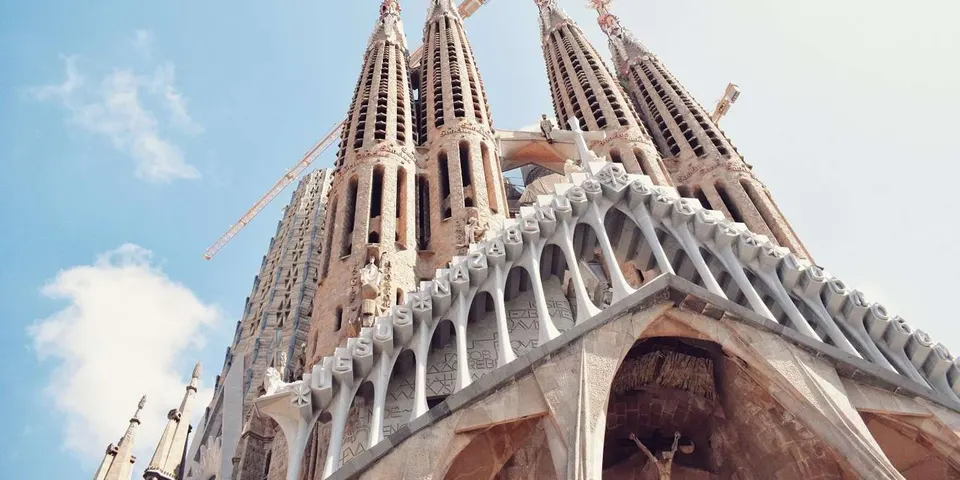
On a clear winter morning, Barcelona is cool enough for a jacket. Inside, the tree-like stone columns rise to the vaults, and the windows throw blues, greens, reds and oranges across the nave.
My recommendation: choose January for a classic winter city break, ideally after the Three Kings holiday on 6 January, and February if you want more daylight for the rest of Barcelona. Inside the basilica the two months give you the same visit, and the weather on your actual day matters more than the small difference in averages.
January and February compared
| Feature | January 2027 | February 2027 |
|---|---|---|
| Average daytime high | 14.2°C (58°F) | 14.7°C (58°F) |
| Average rainy days | 4.4 | 3.6 |
| Average sunshine | About 120 hours | About 147 hours |
| Monday to Saturday hours | 9 a.m. to 6 p.m. | 9 a.m. to 6 p.m. |
| Sunday hours | 10:30 a.m. to 6 p.m. | 10:30 a.m. to 6 p.m. |
| Short days | 1 and 6 January (9 a.m. to 2 p.m.) | None in the published schedule |
| Official adult ticket | €26 (October 2026 price) | €26 (October 2026 price) |
| Best for | Low winter sun and a post-holiday trip | Longer sightseeing days |
Weather figures are Barcelona Airport averages for 1991–2020, the same normals used in our month-by-month guide, and are not a forecast for 2027. Recheck prices and visitor rules when 2027 tickets go on sale.
Visiting in January: what to expect
January opens with the tail end of Spain's Christmas season. New Year's Day is 1 January, Three Kings celebrations fill the evening of 5 January, and 6 January (Epiphany) is a public holiday. On 1 and 6 January the basilica's tourist hours are cut to 9 a.m. to 2 p.m.
After 6 January is my favourite part of the month for a simple city break. Ordinary weekdays tend to be calmer than the holiday dates, but the Sagrada Família is still one of Barcelona's busiest sights and no day is guaranteed quiet.
The winter light can be lovely. The basilica's own blog points to the strong Passion-side reds and oranges around the December solstice, and in January the sun stays low enough for warm afternoon light, especially early in the month. A 3 p.m. booking gives you time for the museum and the audio guide before closing.
By the end of January the days are noticeably longer. On 31 January the sun sets at about 6:05 p.m., just after the 6 p.m. closing, so you won't watch the sunset from inside.
Visiting in February: what to expect
February's average daytime high is only about half a degree warmer than January's, but the days lengthen quickly, which helps if you also want Barcelona's streets, viewpoints and other Modernista buildings.
The basilica keeps its November-to-February winter hours, normally closing at 6 p.m. Sunset is at about 6:23 p.m. in mid-February and around 6:40 p.m. by the end of the month, after closing. The afternoon light inside is still beautiful, but a "sunset entry" doesn't work the way it does in early December.
February has its own local festivals. Barcelona celebrates Santa Eulàlia, one of its patron saints, around 12 February, with processions, giants and other traditions in the old town. The Llum BCN light-art festival is usually held in February too. Both are citywide events, not Sagrada Família tickets or shows; check the 2027 programmes.
Is January or February less crowded?
Without daily visitor figures, there's no honest way to call one whole month quieter. The first week of January has the big holidays; the rest of January and ordinary February weekdays usually suit visitors looking for a calmer trip.
If you're flexible, try a Tuesday, Wednesday or Thursday. Early morning has a more contemplative feel, but don't expect an empty nave. If the red and orange stained glass is your priority, the afternoon is the better time, even with more people around.
Since 2 February 2026 the basilica has kept 9 to 10 a.m. as a quiet hour: visitors are asked to stay silent and to use earphones for any audio. It's a rule about the atmosphere, not a promise of fewer people. On Sundays tourist visits start at 10:30 a.m.
The best entry time in January and February
For the warm Passion-side colours, go in around 3:00–3:30 p.m. in January or 3:00–4:00 p.m. in February. Mornings favour the east-facing Nativity windows and their blues and greens. These windows are our suggestion; the effect depends on clear skies, the date and the angle of the sun.
| Date | Approximate sunset | What it means for your visit |
|---|---|---|
| 1 January 2027 | 5:32 p.m. | Tourist hours end at 2 p.m. |
| 6 January 2027 | 5:36 p.m. | Tourist hours end at 2 p.m. |
| 15 January 2027 | 5:45 p.m. | A 3 p.m. slot leaves plenty of time |
| 31 January 2027 | 6:05 p.m. | Sunset just after closing |
| 1 February 2027 | 6:07 p.m. | Sunset after closing |
| 15 February 2027 | 6:23 p.m. | Afternoon sun before the 6 p.m. closing |
| 28 February 2027 | 6:40 p.m. | Daylight left outside after your visit |
Local times, approximate. The low-angle colour is strongest around the December solstice, and late February won't give exactly the same effect. Our winter stained-glass guide compares entry times from November to February.
Weather in January and February
Barcelona's winter is mild compared with much of northern Europe, but mornings and evenings can be chilly, and rain and wind are possible.
| Month | Average high | Rainy days | Sunshine |
|---|---|---|---|
| January | 14.2°C (58°F) | 4.4 | 120 hours |
| February | 14.7°C (58°F) | 3.6 | 147 hours |
These are long-term averages for the airport weather station. Pack a sweater, a jacket, comfortable shoes and a compact waterproof. You won't need snow boots: snow in central Barcelona is rare. The basilica is indoors, so a rainy day still works, although an overcast sky softens the sharp beams of coloured light, and the towers can close in unsafe weather.
January and February opening hours
| Day | Tourist visiting hours |
|---|---|
| Monday to Saturday | 9 a.m. to 6 p.m. |
| Sunday | 10:30 a.m. to 6 p.m. |
| 1 and 6 January | 9 a.m. to 2 p.m. |
Services, building work and events can change access on a given day. March moves to a different seasonal schedule, with longer hours on some days. Check the official opening hours for your date; the holiday dates themselves are covered in our Christmas and New Year opening hours guide.
Tickets: what to buy in winter
These are the official adult prices:
| Official adult ticket | Price | Best for | Our pick on GetYourGuide |
|---|---|---|---|
| Basilica and audio guide | €26 | An independent first visit or photography | Entry Ticket with Audio Guide, from $39, 4.6/5 from 122,191 reviews |
| Official guided tour | €30 | Understanding the architecture and symbolism | Skip-the-Line Entry Ticket & Tour, from $79, 4.8/5 from 15,466 reviews |
| Basilica and one tower | €36 | Views and close-up detail | The Entry Ticket with Audio Guide with its Nativity or Passion tower option |
| Guided tour and one tower | €40 | Both extras | Small Group Tour with Optional Tower Access, $133 with the tower option, 4.6/5 from 1,305 reviews |
Official prices checked October 2026; they are not a guarantee of 2027 prices. GetYourGuide prices are from-prices in US dollars with free cancellation; ratings checked 29 October 2026.
There's no winter discount just for travelling in January or February, but age, student, disability, family and other concessions may apply, and children under 11 go in free.
For a first visit I'd choose the €26 basilica ticket or the €30 guided tour. A live guide costs only €4 more and adds a lot, so take the Skip-the-Line Entry Ticket & Tour if you want the stories behind the stone, and the Entry Ticket with Audio Guide if free time in the nave for photos matters more to you. The €10 tower supplement is optional, involves narrow spaces and stairs, and depends on the weather; our tower verdict covers winter closures.
The central Tower of Jesus Christ is not part of the ordinary tower tickets. Its exterior reached 172.5 metres in February 2026, but work inside it and elsewhere continues. Watch the official announcements for any separate public access in future. Buy direct on the official ticket site, or see every price and discount in our winter ticket guide.
How far ahead should you book?
Official tickets generally go on sale about two months ahead. If you search for a February 2027 date in October 2026 and it isn't there, it probably hasn't been released yet, which is not the same as sold out. Once your date and preferred time are on sale, book, especially for weekends, guided tours in a particular language, towers or family groups.
Official tickets are hard to change or cancel; third-party sellers set their own terms. Compare what each product includes, not just the "skip-the-line" label: everyone still goes through the security check.
What changed at the Sagrada Família in 2026?
The centenary of Gaudí's death brought a major milestone: the exterior of the Tower of Jesus Christ was completed in February 2026 and the tower was inaugurated during the June celebrations. The skyline looks very different, but the basilica as a whole is still unfinished, with interior and other works continuing.
The temporary centenary exhibitions were scheduled to end by 31 December 2026. Don't count on them in January or February 2027 unless the basilica announces an extension. The building, the standard visitor route and the museum are the reason to come.
Seasonal events nearby
1 to 6 January: the Three Kings
Spain's Christmas season runs into early January. Barcelona welcomes the Three Kings with a parade on the evening of 5 January, and 6 January is a family holiday. Check transport and events for your dates; the basilica closes at 2 p.m. on 6 January.
Until 10 January: Els Llums de Sant Pau
A ticketed light trail themed on The Little Prince runs at the nearby Sant Pau Modernist Site from 19 November 2026 to 10 January 2027, closed on 24 and 31 December and 5 January. It's a walk up Avinguda de Gaudí from the basilica; our Christmas lights and market guide has the prices, or see the official Sant Pau site.
February: Santa Eulàlia and Llum BCN
The Santa Eulàlia festival around 12 February and the Llum BCN light-art programme can add a lot to a winter trip. Check the official 2027 dates; an annual tradition is not a confirmed schedule.
How long to spend, and a sample afternoon
Allow 90 minutes to two hours for the basilica, the stained glass, the museum and the audio guide, plus time outside for photos or an optional tower.
| Time | January or February afternoon |
|---|---|
| 2:30 p.m. | Arrive, look at the façade and find your entrance |
| 3:00 p.m. | Enter and go through security |
| 3:15–4:00 p.m. | The nave and columns with the audio guide |
| 4:00–5:00 p.m. | The stained glass and the museum |
| After you leave | The façades from outside; in late February there may still be daylight |
The light you get depends on the weather and the date. An early-morning visit is the alternative for a calmer feel, except on Sundays, when visits start at 10:30 a.m.
Families, accessibility and rainy days
Children under 11 get free basic admission under the current official age rules. The towers are stricter: under-6s can't go up, under-16s must be with an adult, and everyone has to manage the stairs on the way down. With young children, the main basilica is usually enough.
The main visitor route is accessible, with entrance B on Carrer de la Marina for visitors who need it. The towers are not accessible to wheelchair users. The official FAQs explain how to arrange specific assistance.
On a rainy day the interior is still one of the best things to do in Barcelona. The windows give a softer glow instead of bright beams, but the architecture and the museum are just as good. A poor forecast isn't a reason to give up a well-timed ticket.
Getting there and the practical rules
Address: Carrer de Mallorca, 401, 08013 Barcelona. Metro Sagrada Família, lines L2 and L5. The individual tourist entrance is normally on the Nativity side on Carrer de la Marina; follow the instructions on your ticket.
Bring your named ticket, photo ID, a charged phone and earphones for the audio guide, and arrive 10 to 15 minutes before your slot. Dress for a working church (our dress code guide has the details) and wear comfortable shoes. Leave large luggage at your hotel, as there are no suitcase lockers, and note that you can't re-enter once you leave. Photos for commercial use need separate permission.
January and February: FAQ
Is January a good time to visit the Sagrada Família?
Yes. The low winter sun and the calmer city after the holidays make it a good month, especially after 6 January.
Is February a good time?
Yes. February has longer days than January, which makes a full day of sightseeing in Barcelona easier.
Which month is less crowded?
There are no reliable daily visitor figures for either month. The first week of January has holidays; ordinary weekdays later in either month are usually easier.
Is it open on 1 and 6 January?
Yes, but tourist hours on both dates are only 9 a.m. to 2 p.m.
What is the best entry time in January?
Around 3 p.m. on a normal full-hours day, for the warm afternoon light through the stained glass. Early morning feels quieter and brings the cooler colours.
Does the sun set before closing in February?
No. In February 2027 sunset is after 6 p.m., the normal winter closing time.
Is February warmer?
Only slightly. The average daytime high is about half a degree warmer than in January. Check the forecast for your dates.
Does it snow?
Rarely in central Barcelona. Plan for cool, sometimes wet Mediterranean winter weather.
Are tickets cheaper in winter?
No, there is no seasonal discount, although some visitor categories get reduced or free admission.
Do you need the towers?
No. The interior and the stained glass are included in standard admission; the towers are an optional extra.
Is the Sagrada Família finished in 2027?
No. The outside of the central tower was completed in 2026, but other works continue.
Can you visit the central Tower of Jesus Christ?
Not with an ordinary Nativity or Passion tower ticket. Watch the official announcements for any future access.
Can you visit with children or a wheelchair?
Yes. The main basilica suits families and has accessible arrangements. The towers have age, health and mobility restrictions.
How much time should you allow?
At least 90 minutes, ideally two hours, plus time outside to see the façades.
Choose January for the winter atmosphere and February for longer days, then pick your entry time with as much care as the month. For most visitors I'd book an afternoon slot around 3 p.m., allow two hours for the architecture and the audio guide, and check the forecast for your actual day instead of relying on monthly averages. Either month is a fine time to see Gaudí's basilica. Check the official ticket calendar once your dates are on sale.
Sources and further reading
- Official opening hours
- Official prices
- Visitor FAQs
- How the stained glass creates colour (official blog)
- AEMET climate data for Barcelona Airport
- Barcelona sunrise and sunset times
- Els Llums de Sant Pau light trail
Last reviewed 29 October 2026. Prices, 2027 event dates, tower arrangements and holiday access can change; check again before you travel.