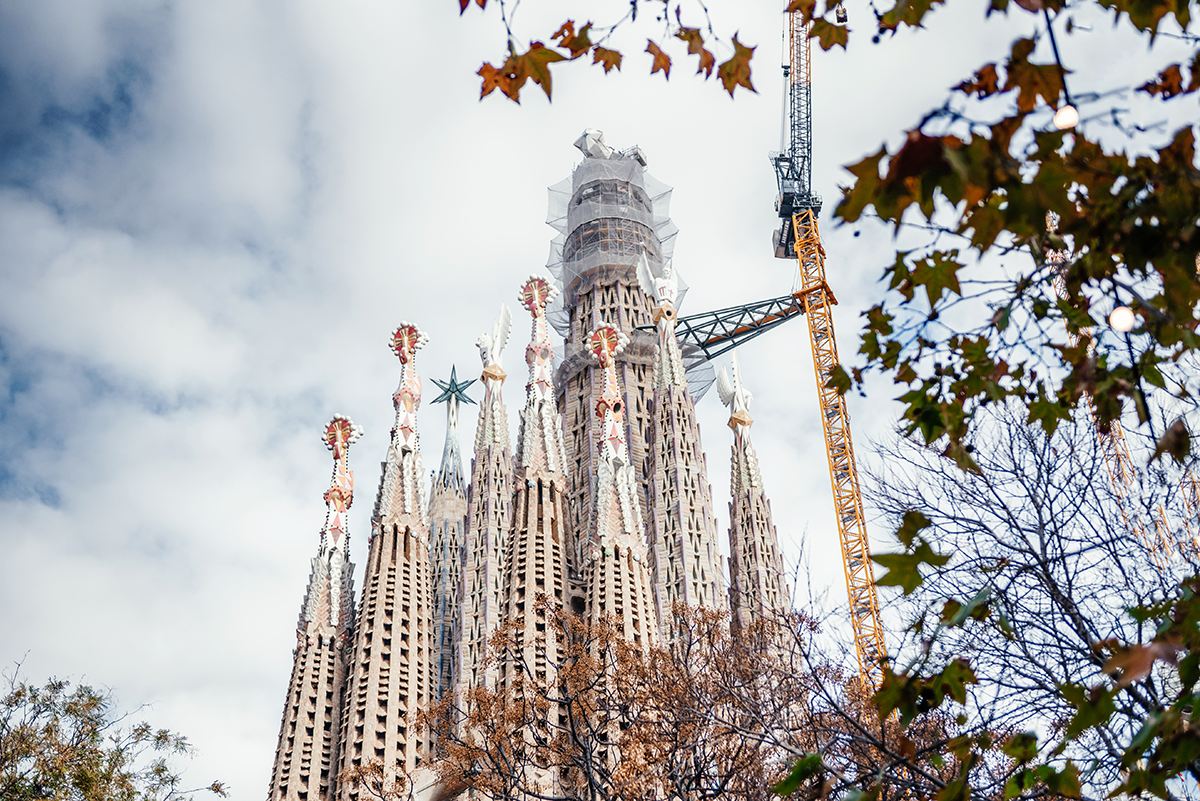
The short version
- The Sagrada Família is not fully finished, but as of 20 February 2026 its exterior structure is — the central Tower of Jesus Christ topped out at 172.5 m, and Pope Leo XIV blessed it on 10 June 2026, the centenary of Gaudí's death.
- Full completion — the Glory Facade, its sculptures and the monumental staircase — is now estimated around 2034, though the Foundation no longer commits to a firm date and the staircase dispute could push parts into the 2040s.
- It's absolutely worth visiting in 2026. Nothing significant is closed to visitors — expect cranes on the south side, record crowds, and the need to book weeks ahead.
"Is the Sagrada Família finished yet?" has been a running joke about Barcelona for over a century. In 2026 the answer finally has real nuance to it: the honest, short version is that the exterior structure is complete, but the building as a whole is not, and probably won't be for close to another decade.
What's actually finished in 2026
The Tower of Jesus Christ. The centrepiece of Gaudí's design is now the tallest element of the basilica at 172.5 metres. The final piece — the upper arm of its four-armed, 17-metre cross — was winched into place on 20 February 2026, surpassing Germany's Ulm Minster to make the Sagrada Família the world's tallest church. Pope Leo XIV celebrated Mass and blessed the tower on 10 June 2026, exactly 100 years after Gaudí's death.
All 18 towers are now built or under construction. The 12 Apostle towers, the 4 Evangelist towers (completed 2023), the Virgin Mary tower (2021) and the Jesus Christ tower (2026) complete the six central towers and the Nativity and Passion facades. Only the four Apostle towers of the still-unbuilt Glory Facade remain.
The interior is complete and open. The nave was enclosed in 2000, the side aisles in 1996, and the apse hyperboloid in 2010. The full interior — nave, transept, apse, crypt and museum — has been open to visitors for years, with no major scaffolding inside. For a full walkthrough of what's actually in there, see our interior guide.
What isn't finished: the Jesus Tower's own interior — cladding and lift work continue through 2027–2028, with a public viewing platform expected in 2027 — and the Glory Facade on the south side, which is the subject of the next section.

Construction timeline: 1882 to now
The scale of the project only really makes sense against its history — 144 years and counting, through a change of architect, a civil war, and a funding model based entirely on ticket sales and donations.
- 19 March 1882 First stone laid, under original architect Francisco de Paula del Villar's conventional neo-Gothic design.
- 1883 Del Villar resigns; 31-year-old Antoni Gaudí takes over and completely reimagines the design.
- 1889 The crypt — the oldest part of the building — is completed.
- 30 November 1925 The first bell tower (Nativity facade) is completed — the only tower Gaudí saw finished.
- 10 June 1926 Gaudí dies after being struck by a tram. An estimated 10–15% of the project is complete.
- 20 July 1936 Anarchist groups burn Gaudí's workshop at the outbreak of the Spanish Civil War, destroying most of his original plans and models.
- 7 November 2010 Pope Benedict XVI consecrates the completed nave and apse as a minor basilica.
- 8 December 2021 The Virgin Mary tower is inaugurated, crowned by its illuminated star.
- 2023 All four Evangelist towers are completed and illuminated.
- 30 October 2025 The basilica becomes the world's tallest church as the tower reaches 162.91 m.
- 20 February 2026 The Tower of Jesus Christ tops out at 172.5 m, completing the exterior structure.
- 10 June 2026 Pope Leo XIV blesses the tower, on the centenary of Gaudí's death.
For the tower-climbing experience itself rather than the construction history, our complete tower guide has a shorter version of this timeline plus what the Nativity and Passion visits are actually like.
The Glory Facade — the last major phase
The Glory Facade is the largest and theologically most significant of the basilica's three facades (Nativity = birth, Passion = death, Glory = the soul's path to God) (what each facade shows), and it's the reason "finished" is still the wrong word for the building as a whole. Vertical construction on its eight Beatitude columns and four Apostle towers began around 2025. The full sculptural programme — more than 100 figures, plus seven bronze doors — is still being developed; three internationally renowned artists were commissioned in 2025 to create sculptural proposals. Decorative completion is currently estimated at around 2034.
Gaudí's design also calls for a grand ceremonial staircase rising over Carrer de Mallorca, which would require demolishing several existing apartment blocks — a dispute rooted in 1970s urban planning that, as Catalan News has reported, "threatens eviction for up to 3,000 people." Negotiations between the Foundation and Barcelona City Council were described as "well advanced" in March 2026, but no binding agreement had been signed as of mid-2026. The Foundation considers the staircase non-negotiable as part of Gaudí's original vision, which is why full completion remains a moving target rather than a fixed date.
Why has it taken so long?
The reasons are cumulative rather than any single cause: a funding model that ties construction speed directly to visitor income (the project receives no government or church funding — 2025 income was €134.5 million, over 96% of it from tickets); Gaudí's death in 1926 with only a fraction built; the 1936 destruction of his workshop and plaster models, which later architects had to reconstruct from surviving fragments and photographs; the sheer geometric complexity of hyperboloids and double-twist columns that had to be reverse-engineered by hand for most of the 20th century; and simply the scale of building the largest unfinished Catholic church in the world. Gaudí himself expected it to take generations, reportedly telling a colleague, "my client is not in a hurry."
Visiting a still-unfinished basilica
Is it worth visiting now, mid-construction? Emphatically yes — 2026 is arguably the best year yet to go. For the first time, the complete silhouette of all six central towers is visible without cranes obscuring the crown, and the newly illuminated cross is a genuinely new sight, reflected in the Plaça de Gaudí pool at night. At the same time, you can still watch a medieval-style building technique happening live, something almost no other generation has witnessed — an experience that disappears once the Glory Facade is finished.
Practically: nothing significant is closed. Entry remains via the Nativity side; the Glory Facade side (Carrer de Mallorca) is an active construction zone and isn't used for visitor access. Expect cranes and scaffolding mainly on the south side — interior views are largely unaffected. For exactly what a ticket costs and includes in 2026, see our tower tickets guide, and for the honest verdict on whether the tower add-on is worth it, see are the towers worth it?
Quick answers
Is the Sagrada Familia finished in 2026?
Not fully, but its exterior structure is. The central Tower of Jesus Christ topped out at 172.5 metres on 20 February 2026, completing all six central towers and making the basilica the world's tallest church. Full completion — the Glory Facade, its sculptures and the monumental staircase — is estimated at around 2034, though the Foundation no longer commits to a firm date.
When will the Sagrada Familia be completely finished?
There's no fixed date. The Sagrada Família Foundation currently estimates the Glory Facade's decorative work will extend to around 2034, but that figure has moved before and depends partly on an unresolved dispute over the monumental staircase, which may not be resolved until the 2040s. Treat any specific completion year as an estimate, not a promise.
Can you go inside the Tower of Jesus Christ?
Not yet. The exterior of the tower was completed and blessed in 2026, but interior cladding and the lift are still under construction through 2027 and 2028. A public viewing platform is expected to open in 2027, not 2026. In 2026, only the Nativity and Passion facade towers are open to visitors — see our complete tower guide for what those visits are actually like.
What percentage of the Sagrada Familia is built?
The exterior structure, including all six central towers, is complete as of February 2026. What remains is the Glory Facade on the south side — its sculptural programme, seven bronze doors and four Apostle towers — plus the monumental staircase. Gaudí himself saw only an estimated 10 to 15 percent complete before he died in 1926.
Is the interior finished, even if the outside isn't?
Yes. The nave, apse, crypt and museum have been open and free of major scaffolding for years — the unfinished part is entirely the exterior Glory Facade on the south side, which isn't part of the standard visitor route. See our full interior guide for what's actually inside.
The Sagrada Família's exterior structure is complete as of February 2026 — a genuine milestone after 144 years — but the building as a whole won't be finished until the Glory Facade and its staircase are done, realistically around 2034 at the earliest. That doesn't make 2026 a reason to wait; it makes it one of the best years yet to visit, with the full tower silhouette finally visible and active construction still there to watch.