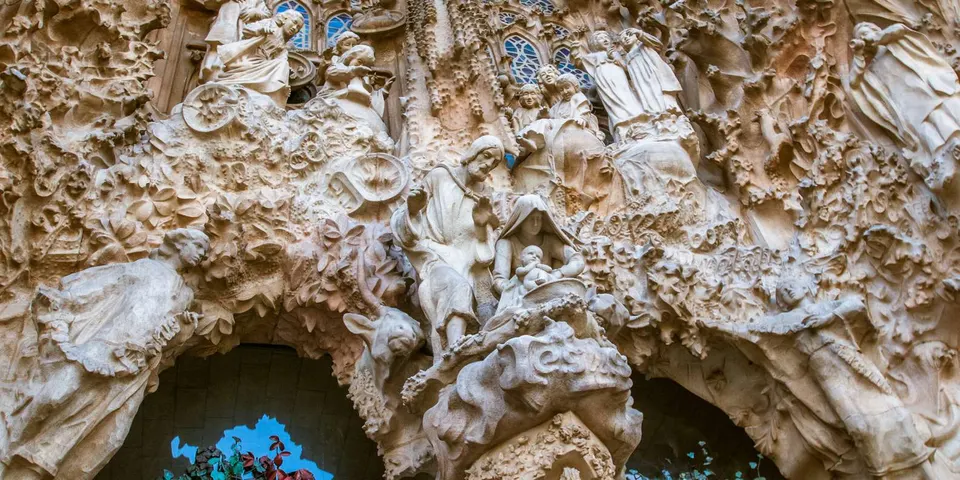
The short version
- The interior is a 45-metre-high "stone forest" of branching, colour-coded columns under vaults faced in gold and green mosaic — most visitors and reviewers say it beats the exterior.
- Joan Vila-Grau's stained glass shifts the whole nave from cool blue-green in the morning (Nativity/east side) to warm orange-red in the afternoon (Passion/west side).
- The standard €26 basilica ticket (audio guide app + museum included) covers the full interior — nave, apse, crypt and museum. No tower add-on is required to see any of it.
- Budget 1.5–2 hours inside. In 2026, Gaudí's centenary year, book online well ahead — slots sell out days to weeks in advance.
Walk in through the Nativity side and nearly every visitor does the same thing: stops, tilts their head back, and stays there for a minute. Antoni Gaudí's stated aim, recorded by his assistant Joan Bergós, was "intimacy with the spaciousness of the forest" — and that's exactly the sensation. What follows is a practical, detailed look at what's actually inside, so you know what you're walking into before you book.
The stone forest — Gaudí's columns
Gaudí's single most important structural invention inside the basilica is the "double-twist" column — a new order, in his words, to succeed the Doric, Ionic and Corinthian. Each column starts as a star-shaped prism at the base and twists in two directions as it rises, morphing through octagonal and 16- and 32-sided cross-sections until it becomes smooth near the top. Inspired by a eucalyptus tree outside his studio, the columns branch at "knots" to support the vaults exactly as a tree distributes load through its limbs — which is what lets Gaudí do away with the external flying buttresses of a Gothic cathedral.
The stone is colour-coded by structural load, and once you know the code it's easy to read as you walk down the nave:
- Red porphyry — the four central columns at the crossing, roughly 24 m high, carrying the greatest load beneath the Tower of Jesus Christ.
- Black basalt — the perimeter columns of the crossing, under the Evangelist towers.
- Grey granite — the central nave columns.
- Montjuïc sandstone — the smaller side-aisle columns.
Above the columns, hyperbolic vaults rise progressively toward the apse — 30 m over the side aisles, 45 m over the central nave, 60 m at the crossing, and 75 m at the apse, the tallest point inside. Between the columns, 289 hyperboloid skylights bring daylight down from above, many filled with golden and green glass. At the crossing, a heptagonal baldachin hangs over the main altar — a single 7,500 kg block of porphyry — with a terracotta Christ figure suspended beneath it.
"Sunshine is the best painter."— Antoni Gaudí, on why he placed clear glass high in the vaults and intense colour low down
Stained glass and the colour compass
The stained glass is the emotional core of the interior, and it isn't random — it follows a deliberate colour logic designed by Barcelona painter and glass scholar Joan Vila-Grau, who worked on the windows from 1999 until shortly before his death in 2022. Across the project he designed over 8,500 m² of glass on the east and west facades.
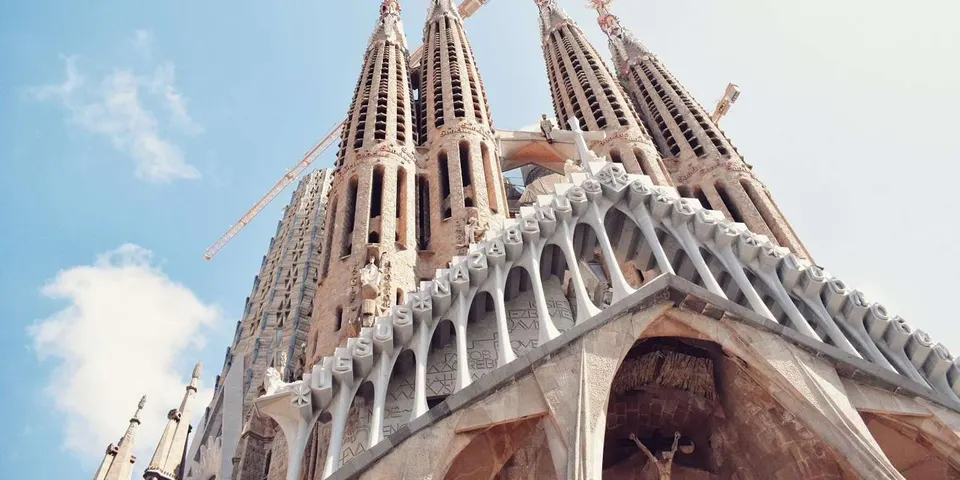
The basilica is oriented so the Nativity facade faces roughly east and the Passion facade faces roughly west, and Vila-Grau calibrated the glass to match:
- East / Nativity side: cool blues and greens — dawn, water, birth. Strongest roughly 9–11 AM.
- West / Passion side: warm reds, oranges and golds — dusk, fire, sacrifice. Strongest in late afternoon.
Gaudí inverted the usual Gothic approach: the most intensely coloured glass sits low down, where visitors can read the names of saints and sanctuaries, while clear or lightly tinted glass sits high up so sunlight illuminates the gold mosaic vaults. Midday light (roughly 11 AM–3 PM) is comparatively flat and washed out — it's also the most crowded window of the day, so it's worth avoiding on both counts.
What's finished inside in 2026
The interior itself has been substantially complete for years: the nave was enclosed in 2000, the side aisles in 1996, and the great apse hyperboloid in 2010. In February 2026 the basilica's central Tower of Jesus Christ reached its final height of 172.5 metres, making the Sagrada Família the world's tallest church, and Pope Leo XIV blessed the tower on 10 June 2026 — the centenary of Gaudí's death. None of that changes what you see inside: the full interior, nave, transept, apse, crypt and museum, is open, free of major scaffolding, and not affected by the ongoing construction on the building's south side.
The interior is done, but the exterior Glory Facade is still years from completion and the Jesus Tower's own viewing platform isn't expected to open until 2027. Our full 2026 construction status guide covers what's built, what isn't, and when the rest is expected.
Tickets and what the interior costs
Official 2026 prices, from sagradafamilia.org — all tickets are sold online only and are timed-entry:
| Ticket type | Adult price | What's included |
|---|---|---|
| Basilica + audio guide | €26 | Nave, both facades from inside, apse, crypt and museum |
| Basilica + guided tour | €30 | Same as above, with a live 50-minute guide instead of the app |
| Basilica + towers | €36 | Everything above, plus elevator access to one tower |
The crypt and the towers are not narrated by the audio guide app itself; the app (19 languages) covers the nave, facades and museum. Reduced rates apply for under-30s, students, seniors and children.
If you'd rather have a live guide walk you through the columns, facades and crypt in person, our ticket vs guided tour comparison breaks down when the guided option is worth the extra cost.
Best route and best time for light
Enter from the Nativity facade (east) side. Stop just inside and look straight up before moving — that first view up the nave is the moment most people remember. Walk down the central aisle toward the apse, watching the columns shift from sandstone and granite to basalt to red porphyry as you approach the crossing. Take one lateral aisle on the Nativity side and one on the Passion side to see the full colour range up close, then head down to the museum and crypt before exiting on the Passion (west) side.
For the light itself: mornings (9–11 AM) give the cool blue-green Nativity-side glow with the fewest crowds, and a daily Quiet Hour runs 9:00–10:00 AM with mandatory earphones and enforced silence — the calmest single window to visit. Late afternoon brings the warm red-orange Passion-side glow. For a full month-by-month breakdown of timing, crowds and tower photography, see our best time to visit guide.
Symbolism most visitors miss
- The tortoise and the turtle. At the Nativity facade, the two columns flanking the central portal rest on a land tortoise and a sea turtle — symbols of permanence.
- "JMJ." The Jesus–Maria–Josep monogram appears in the crossing floor and on the pews, Gaudí's shorthand for the Holy Family.
- Diocesan shields. Every column carries meaning — the crossing columns represent the Evangelists, the transept columns the Catalan dioceses, and so on outward through the nave.
- Columns to towers. The four central porphyry columns carry the load straight up into the six central towers — the interior forest is literally the root system of the skyline above.
Is the interior worth it?
The near-universal verdict: yes, and the interior is the reason. Travel writer David Nikel, writing in Forbes in May 2026, put it plainly: "Sagrada Familia is the opposite [of most landmarks that disappoint inside]. The interior changes the experience completely. Gaudi's columns branch toward the ceiling like trees, creating the sensation of standing inside a stone forest." Catalan architect Oscar Tusquets Blanca went further: "If you see architecture principally as space and light, the interior of this church is Architecture with a capital A, exciting and grand." The most consistent complaint isn't the building — it's the crowds, especially 11 AM–3 PM, which is exactly why the light-timing advice above matters.
Quick answers
What does the inside of the Sagrada Familia actually look like?
A 45-metre-high canopy of branching, tree-like stone columns in four colours (red porphyry, black basalt, grey granite and sandstone), under vaults faced in gold and green mosaic, lit by stained glass that shifts from cool blue-green on the east side to warm orange-red on the west. Most first-time visitors say the interior is more impressive than the famous facades.
Do I need a tower ticket to see the interior?
No. The standard basilica ticket (about €26) covers the full interior — nave, both facades from inside, the apse, the crypt and the museum — with no tower add-on required. The tower elevator is a separate €10 supplement that takes you up one spire; it does not add anything to the interior visit itself.
How long should I budget for the interior visit?
Most visitors spend 1.5 to 2 hours inside, covering the nave, stained glass, apse and museum. Add 30 to 45 minutes for the crypt and museum if you want to see the catenary models and Gaudí's tomb properly, and 30 to 45 minutes more if you're also adding a tower.
What time of day has the best light for the stained glass?
Morning, roughly 9 to 11 AM, for cool blue and green light on the Nativity (east) side. Late afternoon, roughly 3 to 6 PM in winter or 5 to 7:30 PM in summer, for warm red and orange light on the Passion (west) side. Midday, 11 AM to 3 PM, gives flatter light and the biggest crowds.
Is the interior of the Sagrada Familia finished?
Yes. The nave, aisles, apse, crypt and museum have been complete and open to visitors for years, and the building's exterior structure reached completion in February 2026 with the Tower of Jesus Christ. What's still unfinished is the Glory Facade on the south side, which isn't part of the standard visitor route. See our full construction status guide for what's built and what's still underway.
Book the €26 basilica ticket at minimum — the interior is the whole point of the visit, and no tower add-on is required to see it. Pick a morning slot for cool blue-green light or late afternoon for the warm red-orange glow, avoid the 11 AM–3 PM crowd window, and budget 1.5–2 hours. If you also want the elevated view, add a tower for €10 more.