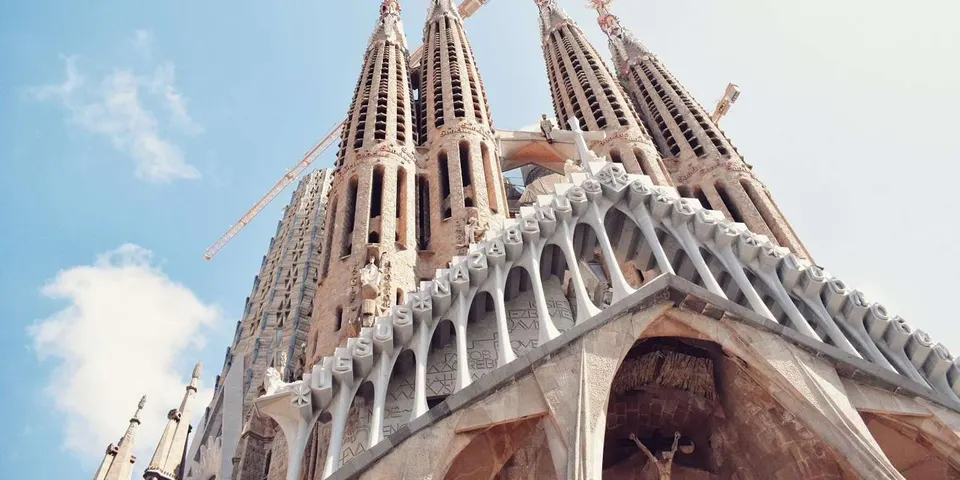
Sagrada Família is open every day of the year, with seasonal closing times, from 9 a.m. (10:30 a.m. on Sundays). Morning is best for the blue Nativity-side windows and afternoon for the red and orange Passion-side windows. Direct sunlight makes the stained-glass colors much more intense, while a cloudy day gives softer, more even color. The blue light is especially strong around the June solstice, and the red and orange light around the December solstice.
For the blue light, choose an early-morning entry. From April to September the sun stays on the Nativity side for most of the morning. From October to March it moves on sooner, so take the first slot of the day, Monday to Saturday, and allow time for the security line. For the warm Passion-side colors, choose the afternoon; in winter the strongest light comes earlier in the afternoon, well before closing.
If you are still choosing dates for Barcelona, May and June are especially good for a first city break, with warm weather and long days before the July and August heat. September is another strong choice for warm weather, while January and February are quieter in the city but have much shorter days. Once your dates are fixed, choose your entry time for the light you want.
The basilica closes at 6 p.m. from November to February and on Saturdays, at 7 p.m. on other days in March and October, and at 8 p.m. on other days from April to September. Tower places are limited, so book them early, and check the forecast before your visit, because the towers can close in bad weather. If your schedule is flexible and basilica-only tickets are still available, booking closer to the date can let you choose a sunnier day.
When to go, at a glance
- Blue Nativity-side light
- Morning
- Red and orange Passion-side light
- Afternoon, well before closing
- Strongest morning light
- June, in the morning
- Strongest afternoon light
- December, in the afternoon
- Barcelona city-break weather
- May–June; September also strong
- A quieter Barcelona trip
- January–February
- Quiet Hour, Monday to Saturday
- Morning, 9–10 a.m.
- Tower visit
- Book ahead; check wind and rain
May and June at a glance
- 72°F / 79°FAverage high, May / June
- 241 h / 250 hSunshine, May / June
- 14h 30m / 15h 09mDaylight, mid-May / mid-June
- 8 p.m.Weekday closing
Allow at least an hour for the basilica, or around 1½ hours with a tower, and remember that visitors are asked to leave 15 minutes before closing. On December 25 and 26 and January 1 and 6 the basilica is open from 9 a.m. to 2 p.m. Tickets go on sale roughly two months ahead.
Entry is by timed slot, and tower places go first. This is the live calendar for a highly rated small-group tour with the tower as an option.
Check your date and entry time
Pick your day, your entry time and your ticket. Within the next two weeks the card uses the live forecast; further ahead it shows the long-term average for that month and says so. It cannot see ticket availability, which the calendar above shows.
Long-term average for September
Morning light on the blue Nativity windows
On a sunny mid-September morning the light comes through the Nativity side, so a 9 a.m. visit has the blue glass lit. A 9 a.m. slot also falls in the Quiet Hour.
- Basilica hours9 a.m. to 8 p.m.
- Time before visitors are asked to leave10 hours 45 minutes
- Expected light inside at your entry timeBlue Nativity windows, low morning sun
- Sunset8:03 p.m.
- Average September sunshine203 hours in the month
- Average high80°F (26.7°C)
- Rainy days in an average September6.0
Beyond the forecast window, so this shows the Barcelona Airport average for September (1991–2020). An average is not a forecast for your day.
What time of day to visit the Sagrada Família
The basilica follows Barcelona's street grid, so it does not face due east and west. The Nativity façade faces northeast, toward Carrer de la Marina, and the Passion façade faces southwest, toward Carrer de Sardenya. The glass is colored to match: the basilica's own blog explains that the windows on the Nativity side are in cool blues for the morning light, and those on the Passion side are in reds and oranges for the evening.
Because the building sits at an angle, the sun moves from one side to the other earlier or later depending on the season. The table gives the general pattern for a clear day. Nearby buildings and the church's own towers shade some windows, and the date checker above shows the expected light for your own date and entry time.
| Season | Sun on the Nativity side | Sun on the Passion side |
|---|---|---|
| November to February | Early morning only; it moves on by mid-morning | Low all afternoon, and almost straight into the Passion windows |
| March and October | Until mid-morning | Lower from mid-afternoon |
| April to September | Through most of the morning | High in the afternoon, lower toward the 8 p.m. weekday closing |
Morning: the blue Nativity windows
From April to September the morning sun stays on the Nativity side for most of the morning, so an early slot gives you time inside with the blue glass lit on a sunny day. The basilica's blog says the effect is strongest in the weeks around the June solstice, when the sun rises furthest to the northeast. In March and October the morning light moves on sooner, so book a slot close to opening on a weekday or a Saturday; on Sundays the basilica does not open until 10:30 a.m. From November to February the sun is low and reaches the Passion side by mid-morning, so the Nativity effect is brief.
A 9 a.m. slot from Monday to Saturday also falls in the Quiet Hour. Since February 2, 2026, visitors must use earphones for any audio between 9 and 10 a.m. every day and are asked to keep quiet. It is a rule about noise, not a limit on numbers, and visits go ahead as normal. On Sundays the basilica opens to visitors at 10:30 a.m., after the 9 a.m. international Mass.
Afternoon: the red and orange Passion windows
The Passion side has the sun for the rest of the day. On winter afternoons the sun is low in the southwest, almost square to the Passion façade, and the basilica's blog names the weeks around December 21 and 22 as the most intense for these windows. From November to February, a mid-afternoon entry gives you an hour inside with the sun low, before the 6 p.m. closing. From November to January the sun sets before closing time, so the strongest light comes earlier in the afternoon.
From April to September the sun is high over the Passion side through the early afternoon, and lower in the last two hours before the 8 p.m. weekday closing, although by then it comes in at more of an angle. Saturdays close at 6 p.m. all year, so a late Saturday visit in summer misses that lower light. On a weekday or a Sunday, an early-evening entry can still leave an hour before visitors are asked to leave, 15 minutes before the 8 p.m. closing.
Cloudy days
Direct sunlight makes the stained-glass colors much more intense. On an overcast day the color inside is softer and more even, and there is no side to plan around. Barcelona averages 105 hours of sunshine in December and 280 in July, but sunny days come in every month, so the forecast for your own date tells you more about the light than the month does.
Other experiences you might enjoy
The basilica takes a morning or an afternoon, and the rest of the day is yours. Walk down Avinguda de Gaudí to the Hospital de Sant Pau, head up to Park Güell, or take in Gaudí's houses on Passeig de Gràcia, Casa Batlló and La Pedrera. The Gothic Quarter, Montjuïc and a flamenco show fill an evening. These are Barcelona tours and tickets that pair easily with a Sagrada Família visit.
Sagrada Família opening hours
The basilica publishes three sets of hours by month. They carry no year, so they should continue into 2027 unless the basilica announces a change, and it says hours can change for special events inside the basilica.
| Months | Monday to Friday | Saturday | Sunday |
|---|---|---|---|
| November to February | 9 a.m. to 6 p.m. | 9 a.m. to 6 p.m. | 10:30 a.m. to 6 p.m. |
| March and October | 9 a.m. to 7 p.m. | 9 a.m. to 6 p.m. | 10:30 a.m. to 7 p.m. |
| April to September | 9 a.m. to 8 p.m. | 9 a.m. to 6 p.m. | 10:30 a.m. to 8 p.m. |
| December 25 and 26, January 1 and 6 | 9 a.m. to 2 p.m., whatever the day of the week | ||
No last-entry time is published. Visitors are asked to leave 15 minutes before closing, and in the last hour only the 25-minute express audio guide is handed out. Enter at least an hour before closing with a basilica ticket, or an hour and a half before with a tower ticket.
How long a visit takes
| Official ticket | Basilica's estimate | Price |
|---|---|---|
| Basilica | About 1 hour | €26 |
| Basilica with guided tour | About 50-minute tour, then free time | €30 |
| Basilica with tower | About 1 hour 30 minutes | €36 |
| Guided tour and tower | About 1 hour 30 minutes | €40 |
The audio guide lasts 45 minutes. The basilica ticket lets you stay in the basilica and museum as long as you like until closing, so these are the basilica's typical times, not limits. Tours booked through resellers cost more because they add a guide and other extras. Allow extra time for the security check on the way in.
Which visit suits you
A sunny morning, April to September
You want the blue Nativity windows
June
when the basilica's blog says the morning blue light is strongest
Book an early-morning slot, and choose a Nativity tower if you add one: it looks over the east of the city. A small group keeps the guided part short, which leaves time to go back to the side aisles while the morning light is still on the blue glass.
Small-group tour, tower optionalA winter afternoon
You want the red Passion windows
5:23 p.m.
sunset in mid-December, before the 6 p.m. closing
Choose a mid-afternoon entry so your hour inside falls while the sun is low in the southwest. A guided tour covers the façades and the nave, then you have free time in the basilica.
Small-group guided tourAny season
You want Park Güell the same day
About 1 hour
the basilica's own estimate for a basilica ticket
Park Güell also sells timed tickets, so the two fit one day with a little planning. A combined guided tour covers both in one booking; our one-day itinerary covers the order and the transfer if you plan it yourself.
Park Güell and basilica tourA windy or wet forecast
You are unsure about the towers
€26 vs €36
official basilica ticket without and with a tower
The towers can close in bad weather and the basilica's refund wording is inconsistent, so in an unsettled week a basilica-only visit avoids the question. The interior is the same visit in any weather.
Skip-the-line guided tourChoosing your Barcelona dates
Barcelona's average highs are 72°F in May, 79°F in June and 80°F in September, rising to 84°F in July and 85°F in August. September and October have the most rainy days of the year, 6.0 and 6.5 on average, and spring can be changeable too. Winter is mild, with average highs around 58°F from December to February, but mid-December has only about nine hours of daylight against 15 in mid-June. The basilica visit itself is indoors apart from the security line and any tower; what the season changes there is the light on the windows and the closing time.
Other experiences you might enjoy
The basilica takes a morning or an afternoon, and the rest of the day is yours. Walk down Avinguda de Gaudí to the Hospital de Sant Pau, head up to Park Güell, or take in Gaudí's houses on Passeig de Gràcia, Casa Batlló and La Pedrera. The Gothic Quarter, Montjuïc and a flamenco show fill an evening. These are Barcelona tours and tickets that pair easily with a Sagrada Família visit.
Sagrada Família opening hours
The basilica publishes three sets of hours by month. They carry no year, so they should continue into 2027 unless the basilica announces a change, and it says hours can change for special events inside the basilica.
| Months | Monday to Friday | Saturday | Sunday |
|---|---|---|---|
| November to February | 9 a.m. to 6 p.m. | 9 a.m. to 6 p.m. | 10:30 a.m. to 6 p.m. |
| March and October | 9 a.m. to 7 p.m. | 9 a.m. to 6 p.m. | 10:30 a.m. to 7 p.m. |
| April to September | 9 a.m. to 8 p.m. | 9 a.m. to 6 p.m. | 10:30 a.m. to 8 p.m. |
| December 25 and 26, January 1 and 6 | 9 a.m. to 2 p.m., whatever the day of the week | ||
No last-entry time is published. Visitors are asked to leave 15 minutes before closing, and in the last hour only the 25-minute express audio guide is handed out. Enter at least an hour before closing with a basilica ticket, or an hour and a half before with a tower ticket.
How long a visit takes
| Official ticket | Basilica's estimate | Price |
|---|---|---|
| Basilica | About 1 hour | €26 |
| Basilica with guided tour | About 50-minute tour, then free time | €30 |
| Basilica with tower | About 1 hour 30 minutes | €36 |
| Guided tour and tower | About 1 hour 30 minutes | €40 |
The audio guide lasts 45 minutes. The basilica ticket lets you stay in the basilica and museum as long as you like until closing, so these are the basilica's typical times, not limits. Tours booked through resellers cost more because they add a guide and other extras. Allow extra time for the security check on the way in.
Which visit suits you
A sunny morning, April to September
You want the blue Nativity windows
June
when the basilica's blog says the morning blue light is strongest
Book an early-morning slot, and choose a Nativity tower if you add one: it looks over the east of the city. A small group keeps the guided part short, which leaves time to go back to the side aisles while the morning light is still on the blue glass.
Small-group tour, tower optionalA winter afternoon
You want the red Passion windows
5:23 p.m.
sunset in mid-December, before the 6 p.m. closing
Choose a mid-afternoon entry so your hour inside falls while the sun is low in the southwest. A guided tour covers the façades and the nave, then you have free time in the basilica.
Small-group guided tourAny season
You want Park Güell the same day
About 1 hour
the basilica's own estimate for a basilica ticket
Park Güell also sells timed tickets, so the two fit one day with a little planning. A combined guided tour covers both in one booking; our one-day itinerary covers the order and the transfer if you plan it yourself.
Park Güell and basilica tourA windy or wet forecast
You are unsure about the towers
€26 vs €36
official basilica ticket without and with a tower
The towers can close in bad weather and the basilica's refund wording is inconsistent, so in an unsettled week a basilica-only visit avoids the question. The interior is the same visit in any weather.
Skip-the-line guided tourChoosing your Barcelona dates
Most visitors fit the basilica into a longer Barcelona stay, so choose the dates for the city, then the hour for the basilica. May and June are warm without the peak heat, with average highs of 72°F and 79°F, and they have more sunshine and fewer rainy days than September and October, the two wettest months of the year. July and August are the hottest, with average highs of 84°F and 85°F.
From November to March the city is cooler and quieter, with average highs of 58°F to 64°F, and the basilica closes at 6 p.m. from November to February. Apart from the security line and any tower, the basilica visit is indoors in every month; what the season changes is the light on the windows and the rest of your day.
How the visit changes through the year
Winter: November to February
The basilica closes at 6 p.m. every day, and the sun is low enough to shine almost straight into the Passion windows through the afternoon. From November to January it sets before closing, around 5:25 p.m. in mid-December. Barcelona has its least sunshine now, 105 hours in December and 120 in January, so a clear day matters more for the glass. On December 25 and 26 and January 1 and 6 the basilica is open only from 9 a.m. to 2 p.m., and on December 23, 2026 there is a concert and a lighting of the Nativity façade at 7 p.m., after closing. The basilica also holds a Mass for the Immaculate Conception on December 8, 2026; it has not said whether visiting hours change that day.
Spring: March to May
Weekday closing moves to 7 p.m. in March and to 8 p.m. from April. The clocks go forward on March 28, 2027, which moves sunset an hour later overnight. Holy Week falls from March 21 to 28 in 2027, and Catalan schools are on their Easter break from March 20 to 29. The basilica is a working church, so check its calendar for services that week. Sunshine rises from 195 hours in March to 241 in May, and the morning sun stays longer on the Nativity side as the weeks go on.
Summer: June to August
Weekday and Sunday hours run to 8 p.m. and sunset comes after 9 p.m., so the lowest evening sun falls after closing. The basilica's blog puts the strongest blue light on the Nativity side in the mornings around June 20 and 21. This is also the hottest and one of the busiest stretches in Barcelona, which makes booking ahead more important, especially for towers.
Autumn: September and October
For La Mercè, the basilica holds free Open Doors Days on September 24 to 27, 2026, from 4 to 8 p.m. (3 to 6 p.m. on Saturday, September 26), with 20,000 tickets given out by draw. The basilica has not said how those afternoons affect paid visits, so check availability if your visit falls then. September and October have the most rainy days of the year in Barcelona, 6.0 and 6.5 on average. October closes at 7 p.m. on weekdays. Sunset is around 7:10 p.m. in mid-October and moves an hour earlier, to about 6 p.m., when the clocks go back on October 25, 2026.
Building work continues through the year. The Tower of Jesus Christ was inaugurated on June 10, 2026, but it is not open to visitors, and the basilica has not given a date. Our guide to whether the Sagrada Família is finished has the construction details.
Barcelona month by month
| Month | Average high | Rainy days | Sunshine | Daylight | Sunset | Barcelona hotel guests (index) | Weekday closing |
|---|---|---|---|---|---|---|---|
| January | 58°F (14.2°C) | 4.4 | 120 h | 9h 30m | 5:45 p.m. | 76 | 6 p.m. |
| February | 58°F (14.7°C) | 3.6 | 147 h | 10h 37m | 6:23 p.m. | 82 | 6 p.m. |
| March | 62°F (16.8°C) | 4.4 | 195 h | 11h 53m | 6:57 p.m. | 94 | 7 p.m. |
| April | 66°F (18.9°C) | 5.6 | 211 h | 13h 18m | 8:30 p.m. | 105 | 8 p.m. |
| May | 72°F (22.2°C) | 4.6 | 241 h | 14h 30m | 9:02 p.m. | 111 | 8 p.m. |
| June | 79°F (26.2°C) | 3.2 | 250 h | 15h 09m | 9:26 p.m. | 109 | 8 p.m. |
| July | 84°F (29.0°C) | 2.1 | 280 h | 14h 54m | 9:24 p.m. | 114 | 8 p.m. |
| August | 85°F (29.7°C) | 4.2 | 258 h | 13h 52m | 8:53 p.m. | 110 | 8 p.m. |
| September | 80°F (26.7°C) | 6.0 | 203 h | 12h 31m | 8:03 p.m. | 106 | 8 p.m. |
| October | 73°F (22.7°C) | 6.5 | 163 h | 11h 09m | 7:12 p.m. | 111 | 7 p.m. |
| November | 64°F (17.9°C) | 4.7 | 120 h | 9h 53m | 5:33 p.m. | 94 | 6 p.m. |
| December | 58°F (14.7°C) | 4.0 | 105 h | 9h 12m | 5:23 p.m. | 89 | 6 p.m. |
What the figures mean
A rainy day is a day with at least 1 mm (0.04 in) of rain, averaged over 30 years, so 6.5 rainy days in October means roughly one day in five is wet. It says nothing about how long the rain lasts. Sunshine is the total number of sunny hours in the month, which is why July's 280 hours against December's 105 shows up in the stained glass, even though a sunny day is possible in any month.
The hotel-guest column counts check-ins at hotels in the city of Barcelona. It is a guide to how busy the city is, not a count of people inside the basilica, and it leaves out apartments, day-trippers and cruise passengers. Sunset times are for the middle of each month and move by a minute or two a day.
How busy is the Sagrada Família?
The basilica had about 4.88 million visitors in 2025, up about 1% on 2024, which works out at about 13,400 people a day on average. It does not publish monthly or hourly counts, and it does not say which hours are busiest, so this page does not rank the hours by crowd.
For the months, the best free guide is Spain's official hotel survey for the city of Barcelona. In 2025, hotel guests were lowest in January (76, where an average month is 100) and February (82), and highest in July (114), May and October (both 111). Every month from April to October was above average. About 83% of those guests lived outside Spain, so Spanish and Catalan school holidays are only one part of demand.
Cruise ships add to the busier months. The Port of Barcelona counted about 4 million cruise passenger movements in 2025, with May, August and October the heaviest and January to March and December the lightest. Those figures count boardings, landings and passengers in transit, not people visiting the city, so they show the pattern only. Whatever the month, book ahead, and further ahead from April to October.
Tower places go first. When we checked the nine GetYourGuide tours with tower access that this site tracks, on October 9, 2026, the earliest date with a tower place ranged from October 25 to January 4, so tower visits needed booking at least two weeks ahead. A basilica-only visit leaves more room to wait for a sunny forecast.
The towers and the weather
You choose one tower when you book: a Nativity tower, which looks over the east of the city, or a Passion tower, which looks over the city center. You go up by elevator and walk down, bags go in lockers, children under 6 cannot go up, and visitors aged 6 to 16 need an adult with them. Our complete tower guide covers the climb itself.
The towers can close for safety in adverse weather, which the basilica does not define. It publishes no wind limit and no figures on how often that happens, so this page does not call any month riskier. Its refund wording is also inconsistent: the general conditions of sale provide a refund of the tower part when weather closes the towers, while the tower ticket pages say there is no refund. Check the conditions on your own booking, and look at the wind and rain forecast in the date checker before you choose a tower slot. The date checker cannot tell you whether the towers will open; only the basilica decides that on the day.
How we know
Where each figure comes from
- Opening hours, the Quiet Hour, visit lengths, prices and tower rules: the basilica's own site, sagradafamilia.org, including its FAQ, prices page, ticket pages and conditions of sale, read on September 16, 2026.
- Which windows the sun lights: the basilica's blog post on stained glass and light, June 18, 2025. The times in the season table are our own calculation from the sun's position (the standard NOAA method, for the basilica's coordinates, with Spanish summer time applied) and façades facing northeast and southwest, as Encyclopaedia Britannica describes them.
- Average highs, rainy days and sunshine: the 1991–2020 climate normals for Barcelona Airport (WMO station 08181, AEMET 0076) that Spain submitted to the World Meteorological Organization. AEMET's own web table still shows the older 1981–2010 period, so it was not used.
- Annual visitors: the Sagrada Família annual report: 4,877,567 visitors in 2025 and 4,833,658 in 2024.
- How busy Barcelona is: Spain's National Statistics Institute (INE), hotel occupancy survey, table 2078, hotel guests in the city of Barcelona in 2025, residents of Spain and abroad added together and indexed so that an average month is 100.
- Cruise passengers: the Port of Barcelona's monthly traffic statistics: 3,997,441 cruise passenger movements in 2025.
- School holidays: the Generalitat de Catalunya school calendar for 2026–27.
- Tour prices, ratings and review counts: GetYourGuide listings, checked on September 11, 2026. The booking page always has the current figures.
What these figures cannot tell you
- Climate normals describe 30 years of weather, not the weather on your day. The date checker uses a live forecast for the next two weeks.
- The sun times are calculations for a clear day. They ignore shade from nearby buildings and from the basilica's own towers, and they are rounded to the nearest few minutes.
- There is no public monthly or hourly count of basilica visitors. The hotel survey is a city-level guide and counts only hotel guests.
- The basilica publishes no wind limit for the towers and no count of weather closures.
- The official opening hours carry no year. No 2027 schedule has been published, and the basilica's events calendar could not be read in full, so a closure for a special event cannot be ruled out.
- The basilica's own pages disagree on tower refunds after a weather closure.
Best time to visit FAQ
What is the best time of day to visit the Sagrada Família?
It depends on which stained glass you want to see lit. Morning is best for the blue windows on the Nativity side, and afternoon for the red and orange windows on the Passion side. From April to September the morning light lasts longer, while in March and October it is worth booking close to opening. In winter the sun is lower, so the strongest afternoon light comes earlier. The date checker on this page shows the expected light for your own date and entry time.
What is the best month to visit the Sagrada Família?
Choose the month for Barcelona as a whole, then the time of day for the basilica. May and June are especially good for a first city break, with average highs of 72°F and 79°F and long days before the July and August heat. September is another strong choice for warm weather, and January and February are quieter in the city but have much shorter days. For the stained glass itself, the basilica's blog says the colors are most intense in the weeks around the summer and winter solstices.
What are the Sagrada Família opening hours?
From November to February it opens 9 a.m. to 6 p.m., Monday to Saturday. In March and October it opens 9 a.m. to 7 p.m. on weekdays, and from April to September 9 a.m. to 8 p.m. on weekdays. Saturdays close at 6 p.m. all year, and Sundays open at 10:30 a.m. On December 25 and 26 and January 1 and 6 the hours are 9 a.m. to 2 p.m. Visitors are asked to leave 15 minutes before closing, and the basilica says hours can change for special events.
Is the Sagrada Família open on Sundays, and when is Mass?
Yes. Sunday visits start at 10:30 a.m. all year. Before that, an international Mass is held at 9 a.m. every Sunday and holy day of obligation; it is free, with limited capacity, and the entrance is on the Nativity side on Carrer de la Marina. There is also an international Mass every Saturday at 8 p.m., after the basilica closes to visitors. The basilica can change Mass times for special events, so check its worship page before you go.
What is the Quiet Hour at the Sagrada Família?
Since February 2, 2026, 9 to 10 a.m. every day is a Quiet Hour. Visitors must use earphones for audio guides, phones or any other audio, and are asked to keep quiet inside the basilica. Visits go ahead as normal. It is a rule about noise, not a limit on numbers.
How long does a Sagrada Família visit take?
The basilica estimates about 1 hour for a basilica ticket and about 1 hour 30 minutes for a ticket with a tower. The audio guide lasts 45 minutes, or 25 minutes in its express version, which is the only one lent in the last hour before closing. A guided tour takes about 50 minutes. Add time for the security check on the way in.
When is the stained glass most colorful?
On a sunny day, at the hour when the sun is on the side you want to see. The basilica's blog says the effect is strongest in the weeks around the solstices: the blue Nativity windows on mornings around June 20 and 21, and the red and orange Passion windows around December 21 and 22. A cloudy day gives softer, more even color.
Do the Sagrada Família towers close in bad weather?
Yes. The towers close for safety in bad weather, while the rest of the visit carries on. The basilica's own wording on refunds is inconsistent: its general conditions of sale provide a refund of the tower part when bad weather closes the towers, while its tower ticket pages say there is no refund. Check the conditions on your own booking, and look at the wind and rain forecast before you choose a tower slot.
How busy is the Sagrada Família?
Very. It had about 4.88 million visitors in 2025, or about 13,400 a day on average. The basilica publishes no monthly or hourly figures. For the city as a whole, hotel guests in Barcelona were lowest in January and February 2025 and highest in July, May and October, which is a guide to how busy Barcelona is rather than a count of people inside the basilica.
Is the Sagrada Família open at Christmas?
Yes, with shorter hours. On December 25 and 26 and January 1 and 6 it is open from 9 a.m. to 2 p.m., so an afternoon visit is not possible on those days. On December 23, 2026 there is a concert and a lighting of the Nativity façade at 7 p.m., after closing time.
Choose the season for Barcelona, then the hour for Sagrada Família: a morning slot for the blue Nativity windows, an afternoon slot for the red and orange Passion windows, and a basilica-only ticket if the forecast looks poor for the towers.